For conditions such as Alzheimer’s disease, amyotrophic lateral sclerosis (ALS), schizophrenia, glaucoma, and Fragile X Syndrome (FXS), there remains a critical gap in effective and patient-friendly solutions. At Spinogenix, we want to do more than slow disease progression. Patients deserve new therapies that offer renewed hope. Our unique approach has the potential to be used alone as a “monotherapy” or in combination with approved therapies.
Spinogenix is pioneering a new way to treat conditions characterized by the loss or dysfunction of the fundamental building blocks in the brain called synapses, specifically, the connections between neurons allowing us to think, plan, remember, see, and control motor functions. Our novel small molecules have the ability to restore neuronal synapses, with the potential to reverse cognitive and motor function decline – either as standalone treatments or in combination with existing approved therapies.


What Are Brain Synapses and Why Are They Important?
Brain Synapses are connections between neurons through which signals flow from one neuron to another. They are a fundamental and indispensable physical basis for neural communication, enabling cognition, movement, perception, memory, and other faculties of mind. Deterioration of brain synapses is an early and progressive feature of a broad spectrum of neurodegenerative, neuropsychiatric, and other diseases collectively known as the “synaptopathies”. For any investigational therapy to have a chance at reversing the symptoms of these diseases in patients, it must promote the restoration of brain synapses.
Diseases We Target – The Synaptopathies
Alzheimer’s Disease (AD)
Alzheimer’s Disease is the most common cause of dementia, accounting for ~60-70% of dementia cases worldwide.Alzheimer’s disease is a neurodegenerative disorder that leads to the deterioration of brain cells. It is the primary cause of dementia, which is marked by a decline in cognitive abilities and a loss of independence in daily tasks (Scheltens, 2021). Globally, more than 50 million people are estimated to be living with AD, and this number is projected to grow significantly (Li, 2022). In the US, about 1 in 9 people (11%) age 65 and older has Alzheimer’s dementia (Rajan, 2021).
Alzheimer’s Disease affects nerve cells in the brain involved in learning, memory, and other cognitive abilities, causing a progressive loss of these functions that greatly impact a person’s quality of life. Loss of brain synapses occurs very early in Alzheimer’s and is a major driver of progressive impairments in cognition and memory. Currently, there is no cure for Alzheimer’s Disease, and medications that are approved for use have only a modest effect on symptoms and the rate of disease progression.
Amyotrophic Lateral Sclerosis (ALS)
ALS, also called Lou Gehrig’s disease, is a neurodegenerative disease that results in the progressive loss of motor neurons that control voluntary muscles.
Amyotrophic Lateral Sclerosis (ALS) is a progressive neurodegenerative disease characterized by impairment of the upper and lower motor neurons leading to progressive paralysis and death within 3–5 years of diagnosis (Dhasmana et al, 2022; Feldman et al, 2022).
The condition is so named due to the combination of muscle atrophy and the pathology finding of sclerosis in the lateral corticospinal tracts (Rowland, 1998).
Worldwide incidence of ALS is reported at ~2 cases per 100,000 population per year and prevalence at ~ 6 per 100,000 with mean age at diagnosis at 55-60 years and higher rates in men compared to women (Longinetti and Fang, 2019).
Schizophrenia (SCZ)
Schizophrenia is one of the most debilitating and prevalent psychiatric conditions, affecting around 24 million people worldwide. Schizophrenia affects approximately 24 million people or 1/300 (0.32%) worldwide with typical onset in late adolescence or early adulthood (Saparia et al 2022).
Fragile X syndrome (FXS)
FXS is a neurodevelopmental disorder caused by the full mutation as well as highly localized methylation of the fragile X mental retardation 1 (FMR1) gene on the long arm of the X chromosome (Protic, 2022; Genovese, 2025). Children with FXS are commonly co-diagnosed with Autism Spectrum Disorder, attention and learning problems, anxiety, aggressive behavior and sleep disorder. The prevalence rate of FXS is estimated at 1 in 5000 males and 1 in 8000 females (Tassone, 2012).
Glaucoma
Glaucoma is the leading cause of permanent blindness, affecting around 80 million people globally, including over 3 million in the U.S. Vision loss in glaucoma results from damage to the optic nerve and the death of neurons in the retina, including retinal ganglion cells (or RGCs) that send visual information from the eye to the brain through the optic nerve. Current treatments focus on slowing disease progression by lowering intraocular pressure, which is commonly associated with the condition. However, not all cases of glaucoma are linked to high pressure, and existing therapies have limitations. As a result, there is growing interest in new treatment strategies that aim to protect and regenerate damaged neurons to preserve or restore vision. Synapse loss in the retina precedes symptoms and neural death, raising the prospect that synaptic regeneration may be of therapeutic benefit. Currently, there is no cure for glaucoma.

The Benefits of a Tablet
Many emerging therapies for neurodegenerative diseases such as ALS and Alzheimer’s disease are large macromolecules called “biologics”. These biologics have difficulty penetrating the central nervous system (CNS) and require IV infusion or intrathecal injections. Such therapies, which include antibodies that bind to toxic proteins or oligonucleotides that suppress the expression of a disease-related gene product, are difficult to administer and costly to produce at scale.
At Spinogenix, we develop small molecules designed to cross the blood-brain barrier. Tazbentetol and SPG601 are designed to be taken by mouth as a once-a-day pill, which has multiple benefits: easier administration, better patient compliance, and significantly lower cost. Together, they represent a potentially simple yet powerful approach to treating synaptopathies.
Regenerating Synapses – Tazbentetol and the TAGS Technology Platform
Tazbentetol is Spinogenix’s first-in-class synaptic regenerative therapy – designed not to mask symptoms, but to regrow the brain connections lost to disease. Built on the TAGS™ (Transient Activators of Glutamatergic Synapses) platform, tazbentetol triggers neurons to produce new, functional synapses. Key features of this regenerative approach include:
Correcting Synapses – SPG601 and BK Channel Modulation for Fragile X Syndrome
FXS is the leading inherited form of intellectual disability and a known cause of autism, resulting from the silencing of the Fmr1 gene. This leads to widespread disruptions in synaptic function, linked in part to reduced activity of large-conductance, calcium-activated potassium (“BK”) channels.
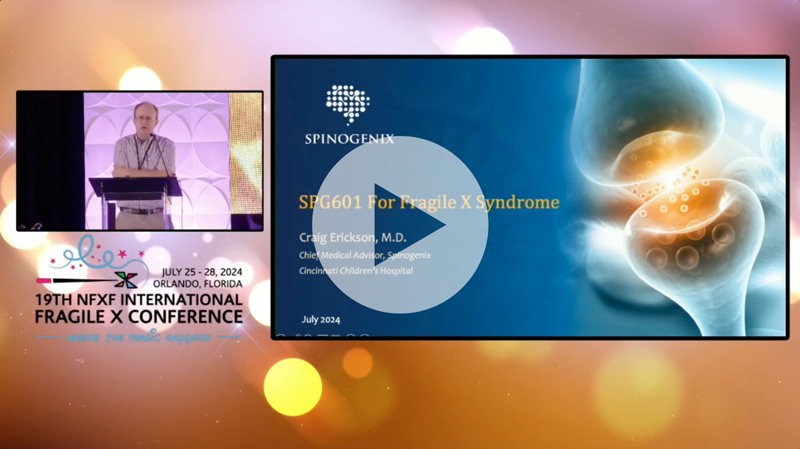
SPG601 is a small molecule that works at the synaptic level, targeting a well-established molecular dysfunction in FXS, to improve core symptoms and challenging behaviors, which can include severe anxiety, social aversion, hyperactivity and attention deficit. SPG601 targets large-conductance, calcium-activated potassium (“BK”) channels, increasing their activation to correct specific synaptic dysfunctions that are thought to underlie many core symptoms of FXS.